
Prof. Dr. Gábor Takács, former chair and professor emeritus of the Department of Petroleum Engineering at the University of Miskolc, has achieved another significant international professional success: The second edition of his book, *Electrical Submersible Pumps Manual*, which covers electric centrifugal submersible pumping, has now been published in Chinese as well, meaning that this globally used textbook now supports the professional work of petroleum engineers and students worldwide in three major languages.
The international history of this technical book spans more than a decade and a half. The first volume, published by Elsevier in 2009, was the world’s first English-language book on electric centrifugal submersible pumping, one of the key methods of oil production.
The second edition of the book was published in English in 2017, also by Elsevier in the United States. Subsequently, a Russian-language edition was published in Kazakhstan by Kazakhstanika in 2025, and a Chinese translation was released by China Petrochemical Press in 2026.
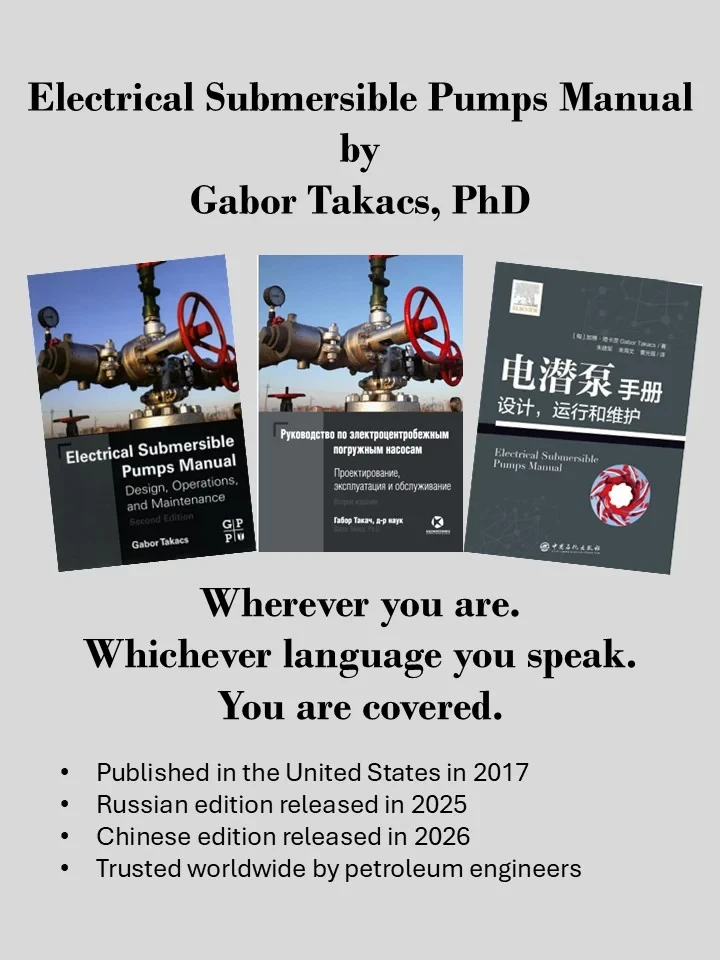
Available in three languages, this volume thus provides useful professional guidance for petroleum engineers and university students working in various parts of the world, while also enhancing the academic reputation of the University of Miskolc through the author’s work.
The Chinese edition also has an interesting feature. While the English-language version is 578 pages long, the Chinese edition is only 377 pages, even though its content is identical to that of the original work. This significant difference stems from the nature of the Chinese writing system: a single Chinese character can convey much more information than a Latin letter, so the same content can be presented using fewer characters and, consequently, in a shorter volume.
With this new language edition of the book, Prof. Dr. Gábor Takács’s work now serves professionals in the field of petroleum engineering and higher education in three world languages, providing yet another example of how a university’s academic achievement can be transformed into knowledge that is useful on an international scale.