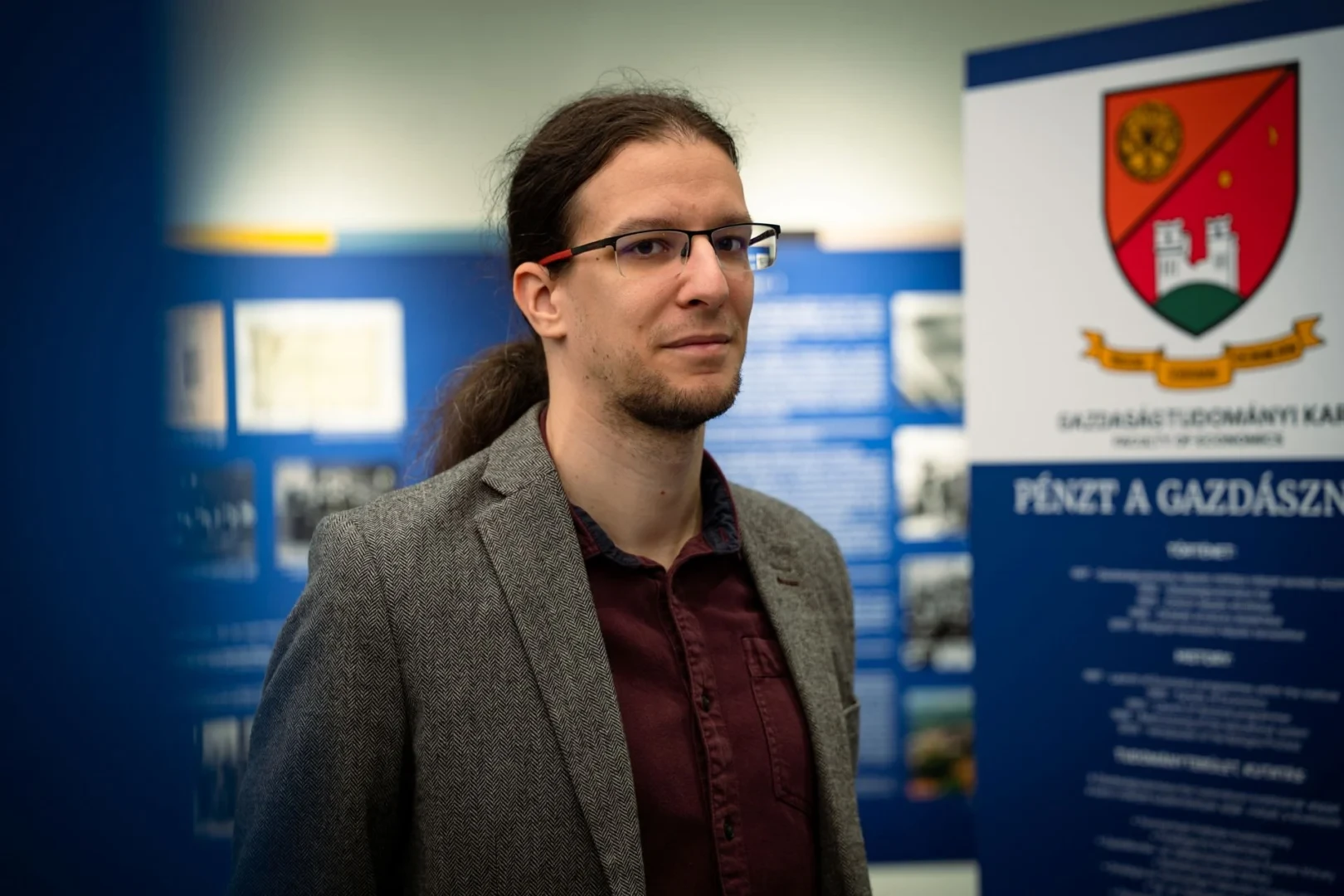

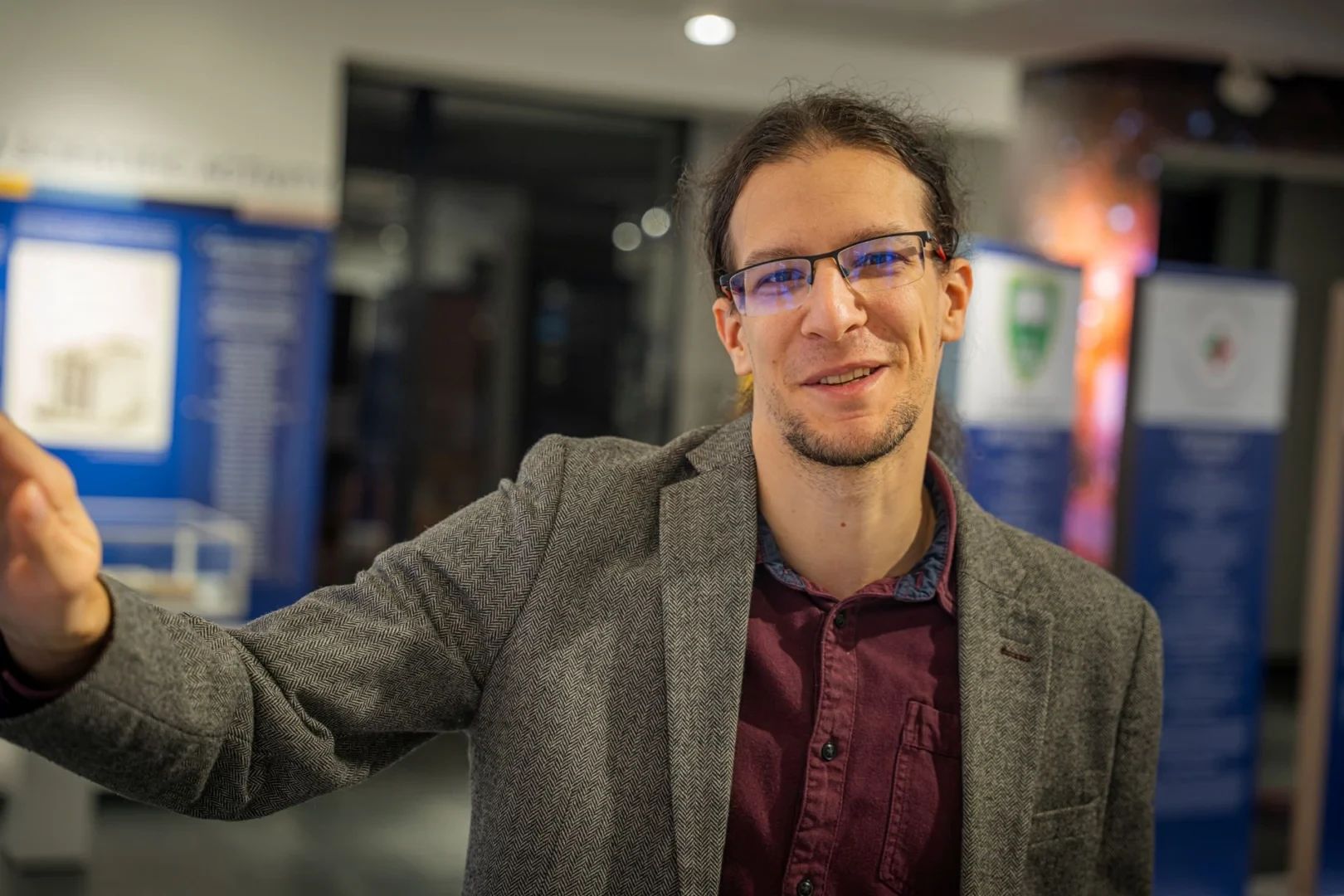
The history of the University of Miskolc is not a closed chapter. The legacy that began in Selmec lives on today, enriching the university’s history with new achievements, new research, and new generations, said Gábor Benkő, curator of the University History Exhibition, which recently reopened under the title “From Selmec to the Space Furnace.”
We spoke with the curator about the background of the exhibition’s renovation, the role of Selmec traditions, scholarly milestones, and how to make a heritage dating back hundreds of years interesting to today’s visitors.
What prompted the renewal of the university history exhibition?
The university history exhibition first opened in 1986 in the university library. Although its foundations proved to be timeless, it is a natural requirement for a permanent exhibition to be renewed from time to time. Over the past nearly four decades, the university has changed significantly: new faculties have been established, new fields of research have emerged, and the institution itself has continued to evolve. The revamped exhibition had to respond to these changes. It was important that it not only present events from the past but also convey that the university’s history is still being written today.
What does the exhibition’s title, “From Selmec to the Space Furnace,” aim to convey?
The title essentially frames the institution’s more than 290-year history. One end of this spectrum is the mining and metallurgy education program founded in Selmecbánya in 1735, which was Europe’s first higher education institution of its kind. The other end point is the development of the space furnace technology, which serves as a powerful symbol of the University of Miskolc’s modern research achievements. The exhibition thus presents both the historical roots and the innovations that continue to define the university’s identity to this day. The exhibition aims to provide a comprehensive overview of this development: it presents the history of education, the most important research findings, everyday university life, and, of course, the student traditions of Miskolc.
It doesn’t seem like an easy task to present a history spanning several hundred years in a limited exhibition space…
Indeed, we had to condense nearly three centuries of events into a 134-square-meter space in a way that would be equally interesting to university students, visiting guests, researchers, and even visitors attending Researchers’ Night. Perhaps the most difficult task was deciding what to highlight and what to leave out. In the history of a university, there are countless events, research projects, and figures that would each deserve their own exhibition.
What scientific milestones did you use as criteria for selection?
The exhibition showcases significant achievements from several eras. Regarding the Selmec period, for example, the development of Hungarian technical terminology is highlighted, a process in which both instructors and students played significant roles. Prominent attention is given to the Szelényi battery, which was an important technical innovation at the end of the 19th century. The interior lighting of the Budapest Opera House at the time was also powered by such batteries. The modern era, meanwhile, is represented, among other things, by the vacuum furnace, which clearly illustrates how far the university’s scientific work had advanced by the 20th and 21st centuries.
How can the student traditions of Selmec be showcased alongside these innovations?
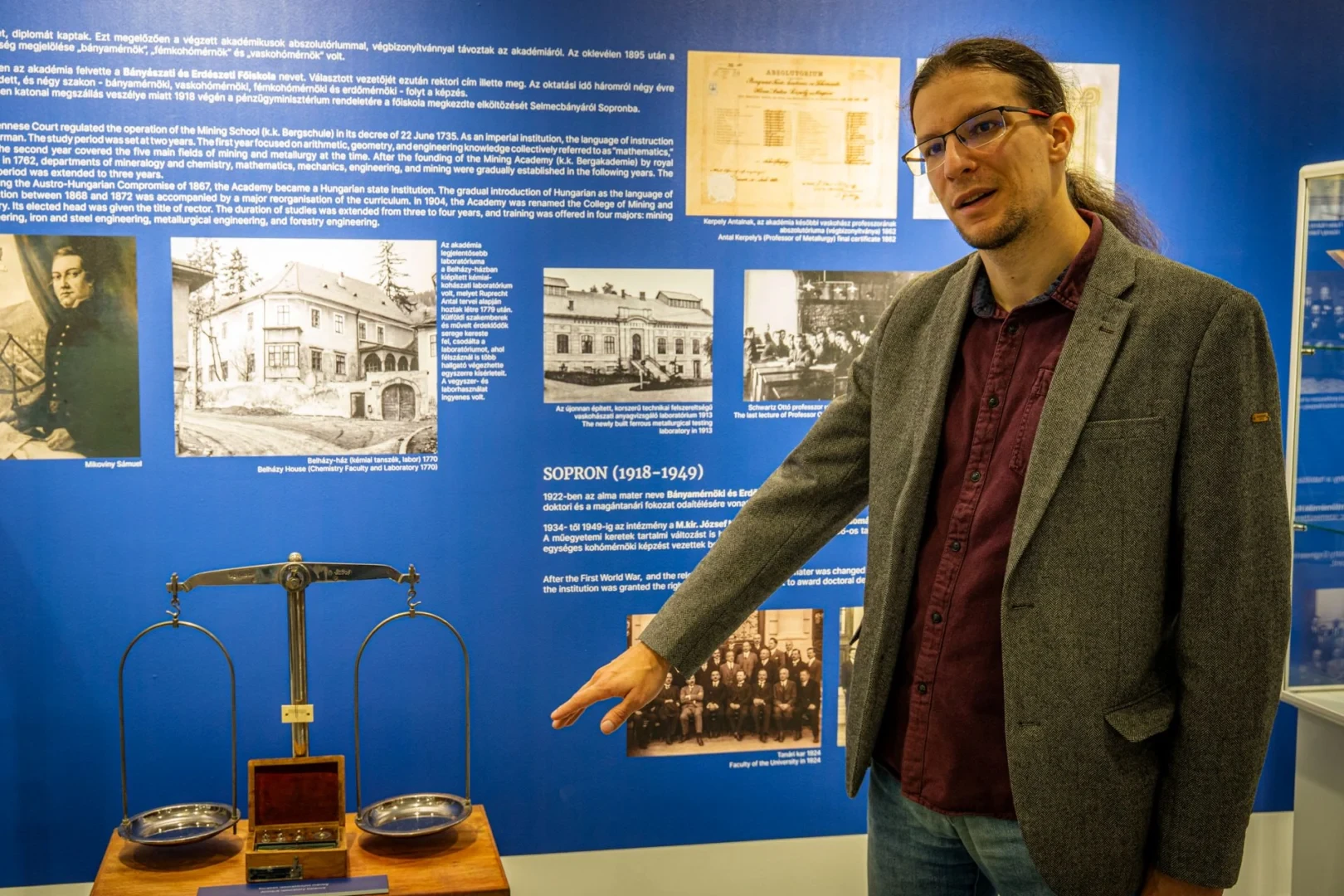
The Selmec traditions form a separate section of the exhibition. This is only natural, as they represent one of the most important pillars of the University of Miskolc’s identity. Visitors can learn about the most important rituals and traditions, and they can also view numerous related artifacts. A separate display case showcases uniforms from various eras, accompanied by a 19th-century photograph, allowing for a direct comparison between historical and contemporary attire.
Jugs also play an important role in illustrating these traditions. The collection preserves pieces representing numerous different events and fraternities, from the “balekkeresztelő” to the “gyűrűavató.”
Is there any object that is considered particularly special?
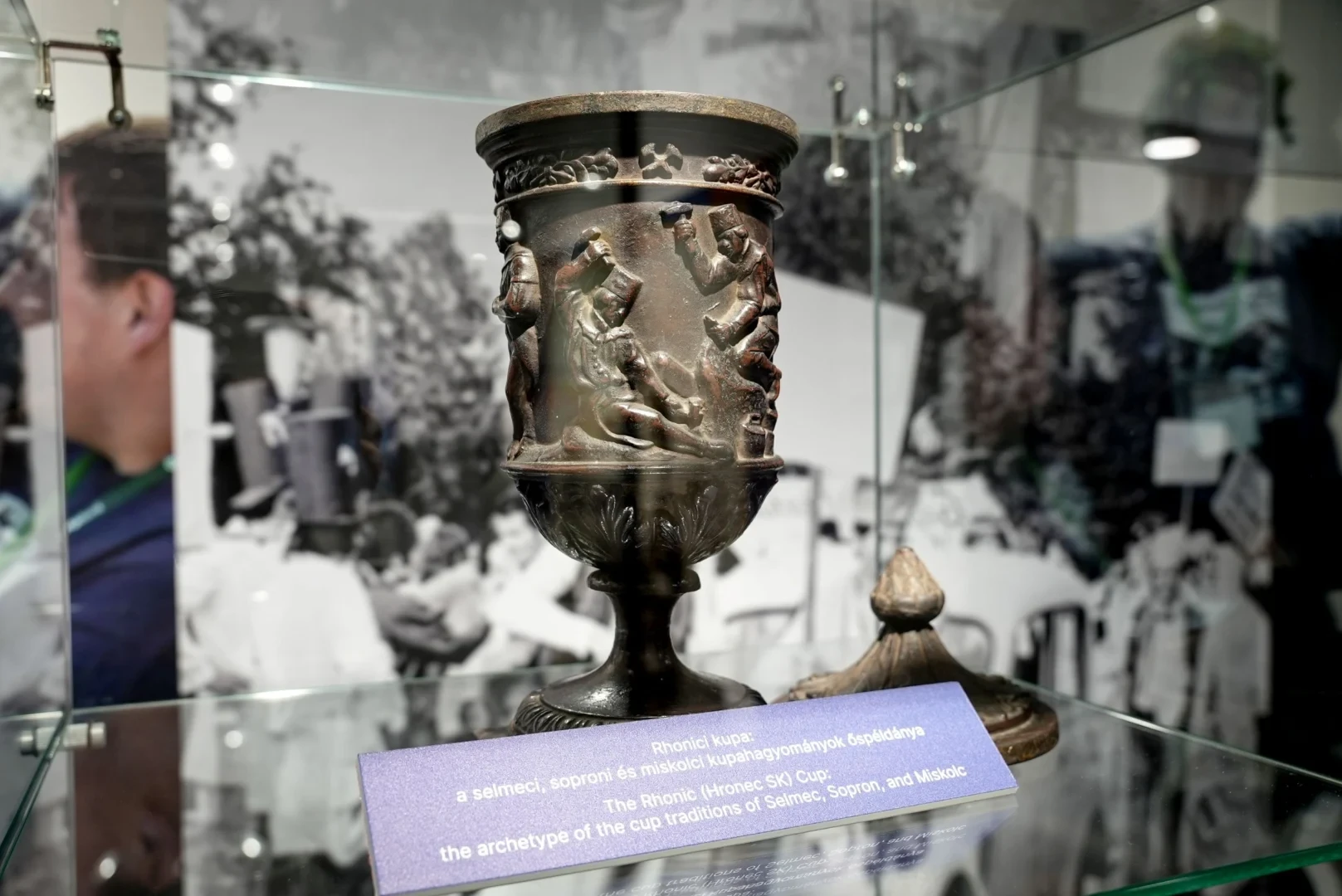
One of the most unique pieces is the so-called Rhonici Cup. This is a large decorative goblet that essentially served as a model for the later cup tradition. The detailed reliefs depict mining scenes, making the object both a memento and a historical document. It is no coincidence that it ranks among the collection’s most valuable items.
Are there any original artifacts from Selmec in the exhibition?
Yes, although the institution has undergone several relocations, wars, and historical upheavals throughout its history, numerous significant objects have survived. Particularly valuable are the original academic medals, which were minted at the time of Maria Theresa’s founding of the academy. These are linked to the 18th century and the institution’s earliest period, and thus hold extraordinary historical significance. The exhibition also features various instruments, laboratory equipment, and educational artifacts.
Do you have a personal favorite item?
If I had to single out one, I would say the academic medals. They beautifully bridge the past and the present, as the tradition lives on today. At the University of Miskolc, academic medals are still awarded today in bronze, silver, and gold, and they use the same iconography that was established in the 18th century. There are few traditions that connect several centuries so directly.
How can we engage young people living in the digital world with an artifact-based exhibition on the history of the university?
This is one of the most important questions facing the museum profession today. However, the goal of such an exhibition isn’t necessarily to incorporate as many digital elements as possible. I believe that the personal experience and the tangible nature of the exhibits can offer so much more. During a guided tour, there’s an opportunity to showcase an old book, tell stories, or even help visitors imagine what it might have been like to be a mining engineer in the 18th and 19th centuries. For today’s generation, what might be particularly special is precisely what they no longer experience in their everyday lives: a direct encounter with the past.
What kind of feedback have you received since the opening of the revamped exhibition?
The feedback has been overwhelmingly positive. Visitors tour the exhibition with great interest, and in many cases, a particular object evokes personal memories for them. Alumni often look for their own mugs or armbands in the display cases. These small moments of recognition are particularly valuable forms of feedback because they show that the exhibition is able to forge a genuine connection between visitors and the university’s past.
When is the University History Exhibition open to the public?
The University History Exhibition can be viewed at the University of Miskolc Library. It’s worth noting that the collection of the Selmeci Historical Library is also located in the adjacent room, which is equally valuable. The exhibition is open Monday through Thursday from 9 a.m. to 3 p.m. and on Fridays from 9 a.m. to 1 p.m. Admission is free. Please check in at the front desk upon arrival; staff will then guide visitors through the exhibition. For group visits, it is recommended to register in advance by contacting the library.